How Missed-Call Text-Back Works for HVAC Companies (And Why It Saves Leads)
By Andre S. Lowe, Jr.
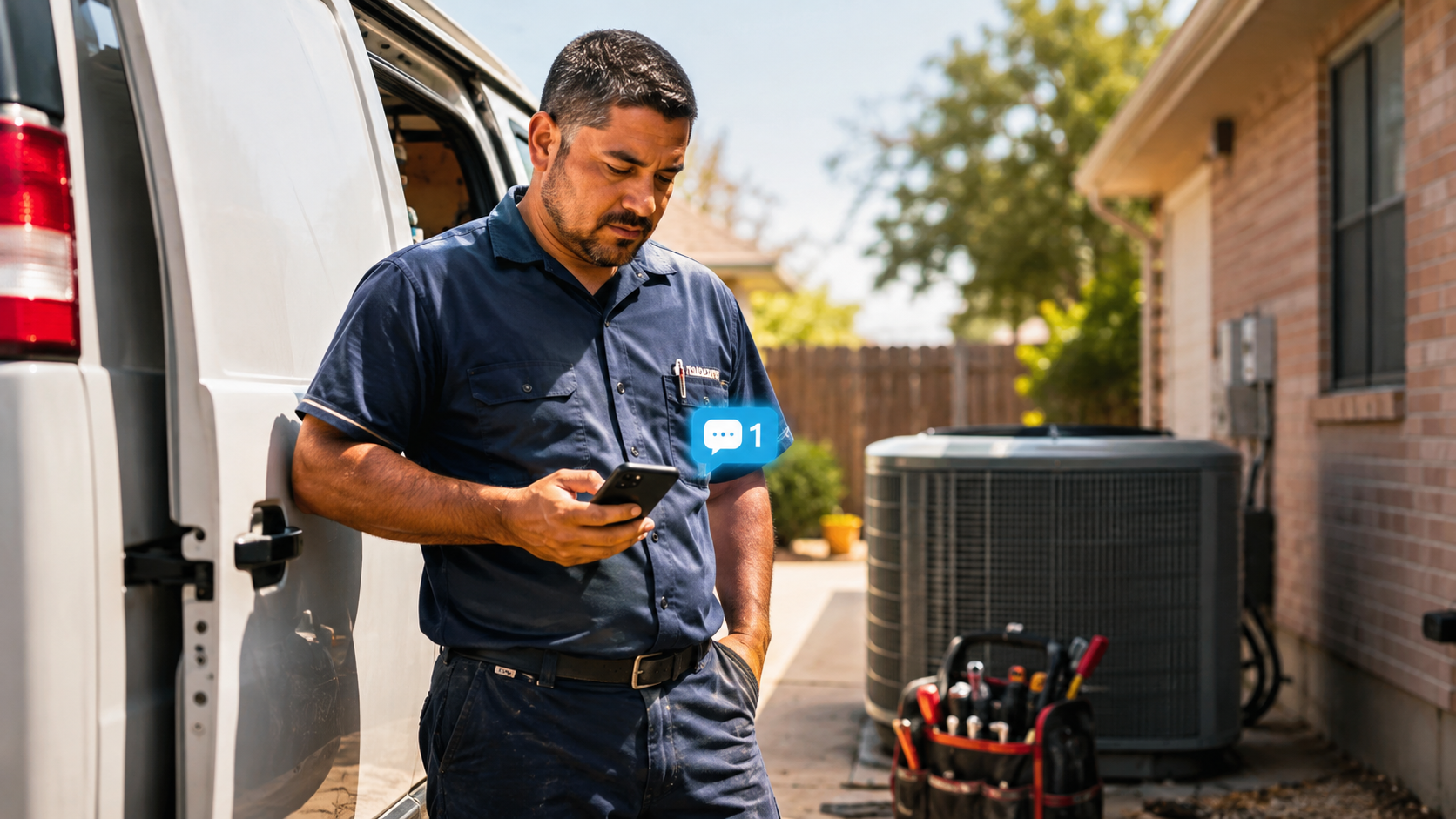
You're forty feet up a ladder checking a condenser unit when your phone buzzes in your pocket. By the time you climb down, wipe your hands, and check the screen, it's already gone to voicemail. No message. Just a missed call and a number you don't recognize.
That caller isn't going to wait around. In the time it takes you to finish the job in front of you, they've already dialed the next HVAC company on the list.
This happens to owner-operated HVAC companies every single day, and it's rarely because of bad marketing or a weak reputation. It's because the person who's supposed to answer the phone is also the person turning the wrench.
Missed-call text-back is one of the simplest ways to stop that leak. Here's exactly how it works, what it fixes, and where it fits for a small HVAC company that doesn't have — and doesn't want — a full-time receptionist.
The Real Problem: It's Not Lead Generation, It's Lead Response
For many HVAC companies, generating more leads isn't the first problem to solve. The first problem is what happens to the leads you're already paying for when the phone rings and nobody can answer. Between Google, referrals, your Google Business Profile, and repeat customers, calls are already coming in — it's what happens next that determines whether they turn into jobs.
A typical day for a small HVAC company looks like this:
You're on a roof, under a house, or elbow-deep in a furnace when the call comes in
You're already on the phone with another customer
It's 7:40 p.m. and you've stopped taking calls for the day
You're driving between jobs and can't safely pick up
None of that means you're bad at running your business. It means you're one person (or a very small team) trying to do the job of a technician, a salesperson, and a receptionist at the same time. Something has to give, and it's usually the phone.
What a Missed Call Actually Costs You
A missed HVAC call isn't just a missed call — it's a missed job, and often a missed customer relationship that could have lasted years.
Think about what's typically on the other end of that call:
A no-cool or no-heat emergency, where the caller is actively calling multiple companies until someone answers
A new customer with no loyalty to you yet, who has zero reason to wait
An estimate request that could turn into a full system replacement
A past customer who trusts you but will still go elsewhere if nobody picks up
When that call goes to voicemail, most callers don't leave a message — they just call the next name on the search results page. You don't lose the lead loudly. You lose it silently, and you may never even know it happened.
How Missed-Call Text-Back Works
Missed-call text-back is exactly what it sounds like, but the mechanics matter. Here's the sequence:
A customer calls your business number and you don't pick up — whether that's because you're on another call, in the field, or it's after hours.
Within seconds, the system automatically sends that caller a text message from your business number. Something like: "Sorry we missed your call! This is [Your Company]. What can we help you with today? We'll get back to you shortly."
The caller responds by text, often describing the problem right there — no-cool, strange noise, need an estimate — instead of waiting on hold or repeating themselves to voicemail.
That conversation and the caller's information are captured and organized so you can see it, respond from your phone or dashboard, and follow up without losing the details.
You call or text back when you're free, already knowing who it is and what they need.
The key difference from a missed call: the customer gets an immediate response, even though nobody physically answered the phone. That response is often enough to keep them from calling a competitor.
A Practical Example
Say it's 6:15 p.m. on a Tuesday. You've clocked out for the day and a homeowner's AC just quit on them. They call your number, it rings through to voicemail, and instead of silence, they get a text within seconds letting them know their message was received and someone will follow up.
Instead of hanging up and calling the next company on Google, that homeowner texts back: "AC not blowing cold air, need someone tomorrow morning if possible." Now you've got their name, their problem, and a clear next step — waiting for you when you check your phone at 7 p.m., instead of a blank missed-call notification with no context.
That's the difference between a lead you lost and a job you booked.
Where Missed-Call Text-Back Fits at AI Advantage Group
At AI Advantage Group, missed-call text-back is one of two ways we implement FrontDesk LeadFlow™, our system for making sure HVAC companies stop losing leads to unanswered calls.
The other path is a full AI receptionist that can actually answer and hold a conversation on the call itself. Missed-call text-back is often the right starting point for owner-operators and small HVAC companies with lower call volume, tighter budgets, or a preference for text-based follow-up over having an AI voice answer live calls. Higher call volume or after-hours emergency coverage sometimes calls for the AI receptionist path instead — we'll walk through that comparison in a separate article.
Either way, the goal is the same: you don't have a lead problem, you have a leak problem, and FrontDesk LeadFlow™ is built to close it.
Built for Owner-Operators in Stafford and the South Houston Business Corridor
AI Advantage Group is a Stafford, Texas-based automation company, and we built FrontDesk LeadFlow™ specifically with small HVAC companies in mind — the kind where the owner is still running calls, running jobs, and running the business all at once. That's the reality for a lot of HVAC contractors across Stafford, Sugar Land, Missouri City, and Pearland, and it's the problem we focus on solving.
FAQ: Missed-Call Text-Back for HVAC Companies
Does missed-call text-back replace answering the phone myself? No. It's a safety net for the calls you can't take — while you're on a job, on another call, or after hours. You can still answer live whenever you're able to.
Will customers know they're texting with an automated system? The message is written to sound like your business, not a robot. Most customers care more about getting a fast response than about who — or what — sent it.
What if the customer wants to talk instead of text? They can call back anytime, and many will once they know someone's paying attention. The text keeps the lead warm until a real conversation happens.
Is this only for companies with office staff? No — it's built for the opposite. Missed-call text-back is designed for owner-operated and small HVAC companies that don't have (and don't want to pay for) a dedicated person answering phones all day.
How is this different from an AI receptionist? Missed-call text-back responds after a missed call. An AI receptionist can answer the call live and have a real conversation. Both are implementation paths under FrontDesk LeadFlow™ — which one fits depends on your call volume and how you want leads handled.
Stop Losing Leads to Voicemail
If you're an HVAC owner-operator in Stafford, Sugar Land, Missouri City, or Pearland and you know calls are slipping through when you can't answer, it's worth seeing exactly how many leads that's costing you.
Start with a free 30-Minute AI Assessment and we'll show you where FrontDesk LeadFlow™ fits your business — no obligation, no pressure.